Red Lipstick Guide: How to Find Your Actual Shade
The real distinction between red lipsticks isn't "bright red" versus "dark red" — it's whether the red leans blue-based or orange-based, and that's what actually determines whether a given red suits your undertone. Blue-based reds (think classic "cherry" or "cool" reds) tend to flatter cool and neutral undertones, while orange-based reds ("brick" or "warm" reds) tend to flatter warm undertones — which is also why the same red can look completely different depending on who's wearing it.
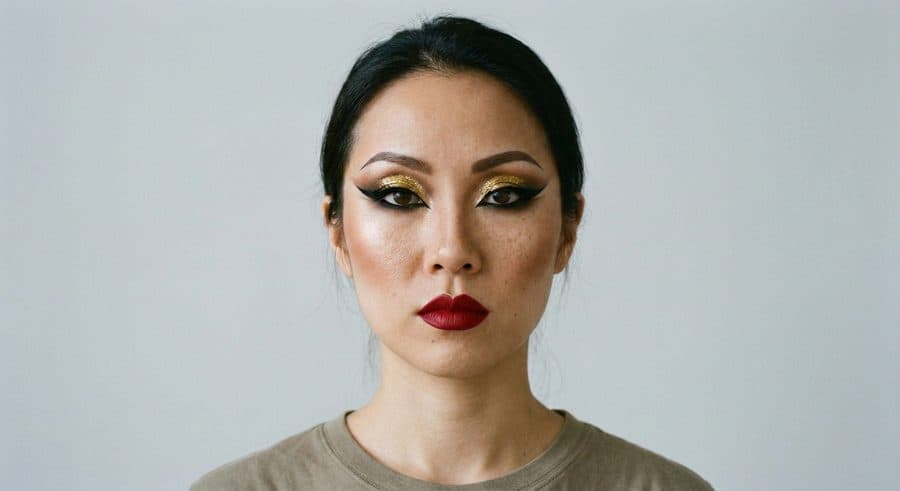

Golden Opera Red Lip rendered on a bare face — synthetic test photo, not a real person
Blue-based versus orange-based: the distinction that actually matters
A blue-based red has a cool, slightly purple or berry undertone and tends to make teeth look whiter by contrast — it generally flatters cool-undertone skin (with pink or blue undercast) and can look slightly flat or muddy on strongly warm-undertone skin. An orange-based red leans warmer and more coral-adjacent, and tends to flatter warm-undertone skin (golden or peachy undercast) while sometimes reading as slightly too orange on cool undertones.
Golden Opera Red Lip in the library is built around a rich, opera-red shade specifically chosen to read well across a range of undertones — a reasonable reference point if you're trying to place where your own preferred red should sit on that blue-to-orange spectrum.
Why swatching on your hand doesn't tell you much
The skin on the back of your hand has different undertone, thickness, and natural pigmentation than your lips, so a red that looks perfect swatched there can shift noticeably once it's actually on your mouth. Lips also often have their own base pigmentation (some people have naturally pink lips, others more brown or muted) that changes how a red reads on top of it — a factor a hand swatch can't show you at all.
Lighting matters more for red than for most other lip colors, since the blue-versus-orange distinction is subtle enough that fluorescent lighting, warm indoor lighting, and daylight can each make the same red look like a slightly different shade.
How to actually see a red on your own lips first
Instead of guessing from a swatch or a shade name, pick Golden Opera Red Lip from the library, or upload a photo of a specific red lipstick look you're considering, and see it rendered directly onto your own photo — on your own lip shape, pigmentation, and skin undertone, in the lighting of your actual photo.
Every result comes with a step-by-step tutorial and the product categories used. First three tries are free, no signup required.
Looks mentioned in this article
See it on your own photo — free, no signup required.
Try AI Makeup On Your PhotoFAQ
How do I know if I need a blue-based or orange-based red lipstick?
Cool undertones (pink or blue undercast) generally suit blue-based reds best, while warm undertones (golden or peachy undercast) generally suit orange-based reds best — if you're unsure which you have, a mid-tone red like a classic opera red tends to work reasonably well on most undertones.
Why does the same red lipstick look different on different people?
Your natural lip pigmentation, undertone, and even the lighting you're standing in all shift how a red reads — the shade isn't changing, but everything it's layered on top of and viewed under is.
Can I try a specific red lipstick shade before buying it?
Yes — upload a screenshot or photo of the red lip look you're considering, and the system analyzes and applies that specific shade and finish to your own photo, rather than a generic red.